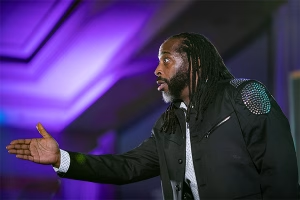
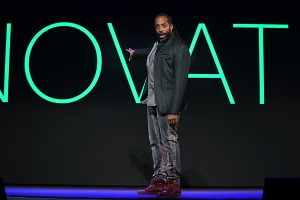
When I step onto a stage, I know I’m not walking alone. I’m bringing my ancestors with me. I’m bringing my mother’s prayers, my father’s fire, and the eyes of every kid who never thought they’d see someone who looked like them with a mic in their hand and a world leaning in to listen.
Representation on stages isn’t a trend. It’s a truth. It’s a necessity. It’s not just about who gets to speak—it’s about who needs to be heard.
Let me be clear: representation on stages still matters. And it always will. Because when you change what people see, you change what they believe is possible. Every time a Black motivational speaker, a spoken word poet, a queer storyteller, a disabled thought leader takes the stage, the world gets a little more accurate. A little more honest. A little more whole.
You see, for too long, certain voices have dominated the spotlight while others waited in the wings. For too long, the front of the room has been reserved for the familiar, the comfortable, the privileged. But the stage is not a sanctuary for sameness. The stage is a platform for possibility. And it is at its most powerful when it reflects the full spectrum of the human story.
When I perform, I do more than speak—I reflect. I reflect the dreams of that young Black girl in the back of the auditorium, wondering if she’s allowed to be loud. I reflect the pride of the immigrant father seeing his struggle woven into my rhyme. I reflect the silent nods of every person who has ever been othered, finally witnessing themselves centered in the spotlight.
This is why I say: representation isn’t a box to check—it’s a mirror to hold up. It’s a window to open. It’s a door to keep propped wide for those coming after us.
Because when we are absent from the stage, it’s not just our stories that go untold—it’s our brilliance that goes unrecognized, our truths that go unchallenged, our genius that goes underutilized. But when we are present—when we claim the mic, when we own our space—something beautiful happens. The air shifts. The audience listens differently. The conversation deepens. And transformation becomes possible.
Representation is not about replacing one voice with another. It’s about making room for more. More nuance. More context. More complexity. It’s about refusing to flatten identity into one dimension and instead celebrating the richness that real diversity brings to a moment, a message, a movement.
As a best Black spoken word artist, I know my presence disrupts expectations. And that disruption is divine. Because when the unexpected voice rises, it teaches us to expect more—from our leaders, from our culture, from ourselves.
Representation isn’t just about who gets the mic. It’s about who gets the message. And when that message comes from someone who feels like home to the listener, it lands differently. It lands with resonance. With recognition. With a sense of “Finally… I see me.”
So whether you are a speaker, a booker, a brand, or an audience member—don’t settle for sameness. Demand stages that are bold enough to showcase difference. That are brave enough to amplify what’s been muted. That are wise enough to know that inspiration doesn’t always come in a package we’ve seen before.
Representation on stages still matters because visibility births possibility. Because every voice we elevate becomes a lifeline to someone else’s dream. Because every speaker who looks like the marginalized, who is the marginalized, who speaks truth with power, plants a flag in the soil of progress.
We’re not asking to be included—we’re already here. We’re asking to be seen. To be celebrated. To be trusted with the mic, the message, and the moment. And when that happens—when the stage finally looks like the world we’re trying to build—then maybe, just maybe, the world will start to listen with new ears.
And that’s when real change begins.