You need to write. Stop thinking about writing and write. Stop worrying if you’re good enough, put “pen to page” and write. “Writers gonna write.”
Poetry is growing in popularity and millions of people spanning the globe have a renewed passion for embracing the creativity, beauty, and art of poetry. Poetry has the power to heal and we make sense of the world through the human expression of writing and reading. Are you wondering: What does it take to become a successful poet? What is the best medium and venue to release your poetry? What are some
techniques to improve or sharpen your skills? In this interview series about how to write powerful and evocative poetry, we are interviewing people who have a love for poetry and want to share their insights, and we will speak with emerging poets who want to learn more about poetry either to improve their own skills or learn how to read and interpret better. Here, we will also meet rising and successful poets who want to share their work or broaden their audience, as well as poetry and literature instructors.
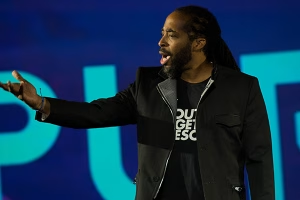
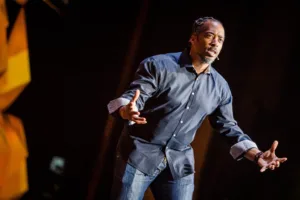
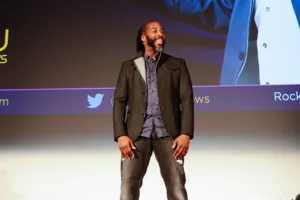
As a part of this series, I had the pleasure of interviewing Sekou Andrews & Steve Connell. As the world’s leading “Poetic Voice,” Sekou Andrews is a schoolteacher turned GRAMMY®-nominated recording artist, two-time national poetry slam champion, actor, thought leader, and award-winning spoken word poet. Steve Connell is an actor, poet, and transformative entertainer whose live performances are as dynamic as the words he delivers. Together as long-time creative collaborators, Sekou & Steve are considered
the most influential poet duo in the spoken word genre.
Thank you so much for joining us in this interview series! Before we dive into the main focus of our interview, our readers would love to “get to know you” a bit better. Can you share a story about what first drew you to poetry?
Steve: My creative writing teacher, Marty Crawford, helped me understand language as a living organism, and not something old, dead, white and male. Plus, having a teacher give me notes made me feel like my voice and poems were worth the effort. I remember on one poem, she told me certain words I’d used weren’t poetic, but once freed, the lightning doesn’t go back. Her attempt to impose limitations ended up
doing the opposite, as I began experimenting with what poetry could be. Before then, poetry came in a burst and was finished, but learning art as process was revelatory; in working on it, Isaw it get better, and that made me want to work on it more.
After college, I found Da Poetry Lounge. It was there I stopped being “someone who writes poems” and became a poet. Embracing being a poet was no small thing. Two years there opened up the world, sharpened me as a writer and performer, and allowed me to win back to back LA/Hollywood Slam Championships, plus 2 National Poetry Championships. And of course, it introduced me to Sekou Andrews and Norman Lear who continue to transform my life to this day. Sekou: What first made me fall in love with poetry was… love. Like so many of us, I wrote my first poems about some girl in high school I was too shy to talk to. I discovered the stage in middle school and began acting and rapping through high school and college. So by the time I started frequenting open mics, I was instantly drawn to spoken word poetry and ended up falling for it hard.
Can you tell us a bit about the interesting or exciting projects you are working on or wish to create? What are your goals for these projects?
Sekou: I’m working toward multiple industry-building projects for spoken word, including reality TV shows, a poetry record label, poetry tours, and a certification program in “poetic voice,” the speaking category I created. Eyes are also set on winning a GRAMMY, finishing my book on hacking inspiration, and expanding my partnership with Steve. My most immediate project is an inspirational expo this summer called The Lightning Machine. Packed with panels, popups, and a next level spoken word concert, the event will celebrate my 20-year career and the mindset of people who chose to stop chasing lightning and start making lightning.
Steve: Beyond developing projects in tv/film, podcasts, publishing, and teaming up with Poetic Voice and Spoken Cinema to transform public speaking, I’ve been creating with my band KillThePoets. It’s an evolutionary shift that I’m eager to share as an album in 2023. Even more so, now that the GRAMMYs have created a spoken word category for poets. Also, I’m pursuing theatrical/digital hybrids, including a piece called “unfinished”, that explores whether the Civil War is still being fought today. My hope is that it will live in theaters and online leading up to the presidential election of 2024.
Wonderful. Let’s now shift to the main focus of our interview. Let’s begin with a basic definition so that all of us are on the same page. What is your definition of poetry? Can you please share with us what poetry means to you?
Sekou: I would define poetry as a literary form of expression that uses poetic techniques to create heightened and imaginative language. I define spoken word poetry as poetry that was written from the ground up to be performed. For me, poetry has been a way to give voice and life to ideas that would have otherwise fallen silent and stagnant inside of me.
Steve: Poetry is tough to pin down. It resists clarity in how we describe it, even as it creates clarity in how it describes us. It speaks on everything and there is nothing it can’t say. It can be incisive and dynamic, long or short, with or without music, solitary or communal, and it lives in every language and doesn’t
have to rhyme. It bursts like lightening across the sky, it is a wild animal lunging in front of your car, an elevator shaft with no elevator, an orgasm, heartbreak, a sliver in the eye, the best bite of food; all these things come upon us, and poetry attempts to hold them all.
What can writing poetry teach us about ourselves?
Sekou: Writing poetry can teach us how we see the world. Poetry reveals our unique lens through which we experience life and enables us to show it to others. Poetry can also help us turn stage fright into Stage Might™. Alliteration and Rhyme can make our content stickier. Cacophony and Onomatopoeia makes language more accessible. Metaphor and Simile can help others relate to our ideas. The mastery of poetic technique can make us mightier communicators in our everyday lives. Steve: We often see the most powerful poetry in people who have been oppressed or told no, or in people that life or society have
attempted to “put in their place”. I think art and poetry breaks us out of those places, and liberates us from anything that would attempt to keep us small. It also helps us make meaning of the darkness in those places, and so often, it becomes a light to help us find our way back.
Who are your favorite poets? Is it their style, the content or something else that resonates with you?
Steve: Pablo Neruda, Langston Hughes, Sandra Cisneros, Ani DiFranco, Tupac, JayZ, Eminem, Dave Chapelle, George Carlin, Bill Hicks, Taalam Acey, Andrea Gibson, Shane Koyaczan, Beau Sia, Sekou Andrews, and my dad.
Sekou: As a professional poet I’m constantly discovering new favorites in different seasons of my life. There are the “iconics,” like Sonia Sanchez, Rumi, Amiri Baraka, and Maya Angelou. The contemporaries, like Andrea Gibson, Talaam Acey, Queen Sheba, Fiveology, Omari Hardwick, and, of course, Steve Connell. Even the lyricists, like Prince, J Cole, Black Thought, Jill Scott, Posdnuos, and Kendrick Lamar. What I love most is just great writing. The beauty of language; a healthy balance of complexity and accessibility. It’s also about unique delivery. I believe that great oration should live strong on the page and come to life on the stage.
If you could ask your favourite poet a question, what would it be?
Sekou: If you could create a world where poets could experience tremendous success and have long, prosperous careers, what would that world, a poet’s ultimate career, look like to you?
Steve: what ‘kou said sounds good. I’ll go with that.
Poetry can be transformational. Is there a particular poem that spoke to you and changed your life or altered a perspective you held in some way? Can you share the story?
Steve: I remember reading “down there” by Sandra Cisneros when I was young. It was profound and profane, honest and raw, and deeply feminine in a way that broke me open as a young man and a writer. It turned things that are so human into something mighty and stood in places where others might feel shame and made miracle of it all. Also, she used poetry as fighting words, which is exactly right.
Sekou: I can’t think of a poem that changed my life as much as poets who did. In my early years, as hip hop began dumbing itself down for sales, I found solace in commercially successful emcees like Rakim, Lauryn Hill and Andre 3000 who gave me permission to be a poet in rap. Not only were they savage with the pen, but they were respected throughout the industry. Through them, I was able to tell the world “I refuse to dumb down, so you better smarten up,” which led me to embrace my pursuit of poetry… which changed my life.
Today’s world needs so much healing. Can you help articulate how poetry can help us heal?
Sekou: Since the launch of my career, I have started most performances with this phrase: “Welcome to the sanitarium. A sanitarium was a place where ‘crazy’ people went to get sane. That’s what spoken word does for my mental health. So, if you’ve had a crazy day, or a crazy night, or a crazy life…if you came here
to getcha mind right…then I greet you with the call of The Sanitarium…holla back: Cuckooooooooo!” That context always helped to anchor the room in community while celebrating the cathartic impact a poet’s words can have on our mental health.
Steve: We live in a world now of two truths. One exists whether we believe in it or not. The other exists only because we believe in it — lies that lodge themselves in our heart and our nervous system, identical to how truth would, and we act on them. This means the truth needs better storytellers, and I think poets are some of the best we have. I think poetry is uniquely adept at cutting through the noise of all the lies and distortions, and reminding us who we are. And I think in remembering who we are, we back away from the stories being told to us by politicians and people who are more concerned with being in power than being worthy of it.
We’d like to learn more about your poetry and writing. How would you describe yourself as a poet? Can you please share a specific passage that you think exemplifies your style or main message?
Steve: Isn’t that what the poems are for? I can only say I believe ideas that can change the world require voices to make the world listen and that is what I hope my work can do. “I have the right to remain silent. I wish to refuse that right. Creativity is limitless. It’s only limit is how you limit it, I refuse to say that I’m limited · Poetry is the proof there’s one spirit broke in 8 billion plus parts.”
Sekou: I just went through a branding exercise where my staff asked a similar question to my fans and clients. Some common responses were: energizing, passionate, healing, inspirational, dynamic, and courageous. I also try to be accessible, emotive, diverse, vulnerable, innovative, and most importantly, always growing.
“What’s the point of showing up to life if you don’t announce you’re there? / What’s the point of having a story if it never gets shared? / When they tell you talk is cheap, tell them silence is unaffordable.”
What do you hope to achieve with your poetry?
Sekou: Last June, I celebrated my 20th year as a full-time poet. The first decade of this career was my “decade of survival.” I quit being a schoolteacher to figure out how to survive as a professional poet. Then came my “decade of purpose and value,” where I realized that my purpose is to help pioneer a mainstream industry for spoken word whereby poets can make a purposeful and profitable living from their art. Next up is my “decade of legacy,” ensuring that the models Steve and I are building will
expand the infrastructure needed to support many more successful poetry careers.
Steve: I want people to think of my work, like I think of the poems and poets I love. The ones who write to ignite, incite, delight and move us into action, reconnect us to our voice and our power, and make us dangerous to the forces that would prefer us to toil in quiet and in servitude. Especially because, as
we consider the question of what services are essential, I feel that art and poetry are becoming increasingly vital to our survival, partly because we are seeing up close how “truth,” stories, and
words are being weaponized against us.
In your opinion and from your experience, what are 3 things everyone can learn from poetry?
Steve:
- Poetry teaches us who we are, and that we are not alone.
2. Poetry helps us make sense of the senseless and reimagine the
world.
3. Poetry is travel tips for the weary traveler from someone who
has been where you are.
Sekou:
- How to find the extraordinary in the ordinary.
2. How to wield language in an empowering and delightful way
to express yourself more imaginatively.
3. How to see the world through a unique lens that connects you to it in transformative ways.
Based on your own experience and success, what are the “five things a poet needs to know to create beautiful and evocative poetry?” If you can, please share a story or example for each.
Sekou:
- You need bravery, the courage to embrace and express your
most authentic and creative self. “You are what you say, so don’t
say what you do, until you do what you are.” - You need to keep growing yourself. Each day we draft
ourselves as human beings. Embrace that same drafting process
for your work. Keep surrounding yourself with writing that
makes you better and be at peace with the iterations of you. “You
are perfection in process / You are rapture en route.” - You need to be inspired. Inspired people inspire people. So,
pay attention to what inspires you and learn to hack that process
so that you can deliver it on command. “You never know when
you will be the recipient of the inspiration you give to the world.” - You need to be human. Disrobe and get naked in your
humanity, in all its beauty and blemishes. “You are humans
being / With adjoining desks and tangential flesh / Common
breath and inevitable death / Trying to find your harmony in
someone’s song before your final rest / To solve the puzzle of a
life well lived and share it with a guest.” - You need to write. Stop thinking about writing and write. Stop
worrying if you’re good enough, put “pen to page” and write.
“Writers gonna write.”
Steve:
- Our language is a mixture of many languages — the languages
we speak, the languages that speak us, the languages we listen to,
and the languages we create throughout our lives; Poetry is
where those languages are unified into a voice, and writing is
how we bring that voice into existence. - Your voice is a unique, blessed, cursed, glorious, terrible, wonderful thing that is all
yours. Trust it. - Sounding too much like other people, comes
at the cost of sounding less like yourself. - Be revelatory in your writing and push the limits of language. Bend it, warp it, twist it,
shape it, divine it; make demands upon it and let it make
demands upon you. - Be brave enough to be terrified and keep writing, and be honest enough to say something real.
If you were to encourage others to write poetry, what would you tell them?
Sekou: Be prepared to unlock a superpower that you never knew you had. A power that will transform how you experience the world and how the world experiences you.
Steve: Sekou and I performed for Maya Angelou’s 75th. The next morning, she put her hand on my shoulder and said, “I mentioned you in my prayers last night… by name.” By name is what got me. By name is the hallmark of a poet. Two words that told me everything. She knew my name, I had made an impact, she remarked on me to God. That is what poetry is. It is the leaning in, and the laying on of hands; it is communication between ourselves and the universe; it doesn’t concern itself with age or gender or race or class- only with a truth that must be told.
How would you finish these three sentences:
Poetry teaches…
Poetry heals by…
To be a poet, you need to…
Steve:
Poetry teaches…us to reveal ourselves.
Poetry heals by…showing our revealed self to others.
To be a poet, you need to…reveal yourself
Sekou:
Poetry teaches…people to communicate in ways that are unexpectedly more moving and memorable.
Poetry heals by…connecting us to our world, our experiences, and ourselves in ways that transform us. To be a poet, you need to…be more than mindful, be more than soulful …be voiceful.
We are very blessed that some of the biggest names in Entertainment, Business, VC funding, and Sports read this column. Is there a person in the world, or in the US, with whom you would love to have a private breakfast or lunch, and why? He or she might just see this, especially if we both tag them 🙂
Steve: Bo Burnham, Childish Gambino, Beyonce, Kendrick Lamar, Dave Chapelle, Lebron James, Lyn Manuel Miranda, and Barack Obama are all on the list for the same reason. I think they do something exceptional that is comparable to their peers, and then there is something extra that makes them legends. That something else is poetry and I’d love to talk to them about that.
Sekou: Queen Latifah! I have always been a huge fan of how she has experienced success in so many areas of media all while maintaining her sense of consciousness and authenticity. I’d be
so honored to swap stories with that Living Legend over funnel cakes. Tea party on me Queen!