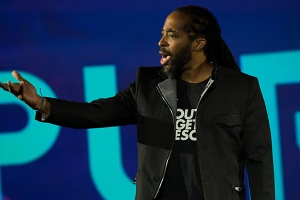
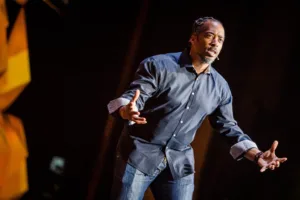
You know the meeting. The one where good ideas go to die. The energy is electric, someone throws out a game-changer, a real “what if” moment that could reshape everything. And then it happens. The two-letter word that sucks all the oxygen out of the room. “But.” “That’s a great idea, but we don’t have the budget.” “I see where you’re going, but that’s not how we’ve always done it.” “Sure, but what will legal say?” Suddenly, the trailblazer in the room is roadblocked by the ‘But-Head,’ and innovation grinds to a halt. We’ve all been there. We’ve all been the ‘But-Head.’ It’s the default setting for a world that fears disruption more than it craves transformation. It’s safe. It’s predictable. And it’s the fastest way to get Kodak’d while you’re still trying to find the perfect filter for your failure.
So how do the world’s best leaders and the most inspirational teams beat disruption to the punch? They don’t just have better five-year plans; they have a better two-word response. As a Grammy Nominated Spoken Word Artist, my job is to get on stage and transform a blank space into an experience. And the secret weapon I use—the one I’ve seen the top, leading innovators use in their own industries—isn’t some complex formula. It’s a simple, foundational principle from improv comedy: “Yes, and…” Think about it. In improv, if your partner says, “Captain, the ship is sinking!” and you say, “No, it’s not, we’re in a desert,” the scene dies. But if you say, “Yes, and I’m turning the lifeboats into sand-skis!”… now you’ve got a story. You’ve got momentum. You’ve turned a problem into a possibility. This isn’t just an acting exercise; it’s a mindset for a world that won’t stop throwing surprises at you. Disruption is rude. It’s relentless. It doesn’t RSVP. The “Yes, and” mindset trains you to welcome it, to see the unexpected not as a threat, but as an offer.
This is the work I do as a motivational poet and speaker. I help people unlearn the “no, but” that’s been drilled into them and embrace the creative power of “Yes, and.” It’s not about agreeing with every bad idea. The “yes” is about acknowledging reality. It’s accepting the offer, the challenge, the disruption. The “and” is where you pivot. It’s where you add your value, your perspective, your creativity. It’s where you become the Vanguard Artist of your own industry. “Yes, our competitor just launched a new feature, and it’s the perfect opportunity for us to show the world why our human-centered approach is what customers really want.” “Yes, the budget got cut, and that forces us to get scrappy and find a more innovative solution.” It’s a way of turning every obstacle into an accomplice, transforming your business keynotes from dry data into powerful spoken word poetry that moves people to action. It’s the engine that drives every great story and every leap of faith.
So, the next time you’re in that room and you feel that two-letter word bubbling up in your throat, I challenge you to make a different choice. Instead of being the But-Head who puts up the roadblock, be the leader who builds the ramp. Your job isn’t just to manage what is; it’s to create what’s next. As I, Grammy Nominated Poet Sekou, have learned on countless stages, the best way to write a new story for the room is to start with a “yes.” Stop being the period at the end of a good idea. Be the ellipses. Be the invitation. Be the “and” that leads to the next… and the next… and the next one after that. Because in a world of constant change, the future doesn’t belong to those who say “no, but.” It belongs to those who have the audacity to say, “Yes, and watch what we do with it.”Show prompt sent to Gemini