We’re drowning in data, but we’re starving for meaning. In our world of results and returns, we’ve got places to go and margins to earn. So we do what we think is efficient. We skip the story and get straight to the point. We treat our customers like my niece asking for the story of Cinderella for the thousandth time, and we just give her the highlights: “Be nice. Be home by midnight. Women love shoes. Good night.” We deliver the data dump, check the box, and wonder why no one feels anything. Here’s the truth: your audience will not stop being moved by powerful stories just because you’re not good at telling them. They’ll simply ask your competitors to tell them instead.
Your audience doesn’t just want the data; they want the experience. Why? Because they are human beings first and customers second. And the quickest way to connect with a human being is not through a spreadsheet, but through a story. The real challenge, and the real opportunity, is to find the human API—the access point that turns cold, hard data into a warm, human dialogue. I had to find this out for myself in a room that, by all accounts, should have been my toughest audience yet.
The Case of the Cardiologists
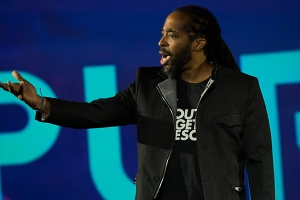
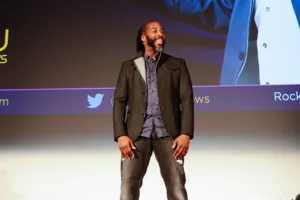
Picture this: a room full of cardiologists. You know how they get down. That’s a lit crowd right there. They live and breathe data, peer-reviewed studies, and clinical trials. And in walks me, a Grammy Nominated Spoken Word Artist Sekou Andrews. The temptation was to try and speak their language, to get up there and pretend to be “Dr. Andrews.” But I knew I couldn’t win on their turf. My job wasn’t to be the best expert on cardiology; my job was to be the leading expert on humanity. So instead of speaking to their business cards, I decided to tell a story to the human beings behind them.
I told them about a patient. Not a chart number or a set of vitals, but a person. A person who was “Diabetes on Wednesday,” “Heart Failure on Tuesday,” and “occasionally neurotic.” A person who had been asked for their data so many times they’d forgotten who they were. But when a provider finally stopped and asked, “No, who are you?”… everything changed. I spoke of a provider who listened to the “unspoken scriptures” of body language, who read the patient “less like a chart and more like a poem.” I used spoken word poetry to paint a picture of a relationship, a connection, a “soul transfusion.” And a funny thing happened. The room full of scientists, doctors, and data-heads… they felt something. After I came off stage, one of them came up to me, eyes wide, and said, “That was crazy. So wait… you’re not a doctor?” In that moment, I was popping my collar. Not because I’d fooled him, but because by telling a human story, they’d listened to me as one of their own.
The Rosé ROI
This isn’t just a theory for the healthcare industry. I once spoke to a room of wine and beverage execs. Their data points were “notes of rosé” and “fragrance profiles.” But nobody buys a fragrance profile. They buy an experience. So I shared stories. I told them their product wasn’t the scent of rose, but the scent of “Tuesday, June 18th, at precisely 2:45 PM,” the moment a bride-to-be toasted with her maid of honor after fitting into her wedding dress. It was the taste of grape juice and biscuits a soldier shared over a webcam tea party with his daughter from Baghdad. For me, it was the glass of rosé I watched my dad drink every day after school to decompress. A few days later, a package arrived at my door from a winery owner in the audience. Inside was a bottle of his rosé and a note, thanking me for reminding him of the power of storytelling. That, my friends, is the ROI of turning data into dialogue. I didn’t sell him anything. I shared a part of myself, and he shared a part of his in return.
That’s the work I get to do as a motivational poet and speaker. As a spoken word artist, I’ve learned that whether you’re selling wine, saving lives, or launching software, your real impact isn’t in your information—it’s in your inspiration. Data is the destination, but the story is the vehicle. The experience is the journey, and the journey is what we remember. People want to see themselves in you, in your brand, in your message. When you tell a story, you give them the chance to find themselves in you, and for you to find yourself in them. You create a dialogue where a data dump only creates a disconnect. So, the next time you’re about to present a deck full of numbers, ask yourself: what is the bedtime story this data is begging me to tell? Find that human API, and you’ll find you have the power to do more than just inform; you have the power to create a goosebump. And a goosebump will always beat a bullet point.