My phone’s autocorrect thinks it’s smarter than me. I’ll be in the middle of typing a heartfelt, all-caps, emoji-laden text to my wife—something raw and real—and it’ll suggest I change “Finna make it home” to “Finalizing market holodeck.” What the hell? It’s like a tiny, well-meaning, but hopelessly corporate intern lives in my phone, constantly trying to translate my soul into a quarterly report. It’s got all my data, it knows who I talk to, but it has zero clue about the human being holding the device. We’ve added the word “smart” to everything we own, from our water bottles to our cat’s food bowl, but in our race to automate our lives, we’re at risk of letting our communication get disturbingly dumb. We’re building a world of incredible connection points, but we’re forgetting the point of connection.
I had this experience recently—you know the one. I was trapped in the automated labyrinth of a customer service line, a digital purgatory of “Press 1 for an answer you don’t need” and “I’m sorry, I didn’t get that.” It was a masterclass in frustration. I was a data point, an account number, a case file to be closed. Then, after threatening the automated voice with things no robot should ever hear, a human being finally came on the line. And she didn’t just read her script. She listened. She laughed at my stupid joke about her robot overlords. She heard the exhaustion in my voice, not just the keywords in my complaint. She didn’t just solve my problem; she performed a quiet miracle, the world’s first soul transfusion through a fiber-optic cable. In that moment, she didn’t just save an account; she restored a little piece of my faith in humanity.
That’s the whole ballgame, isn’t it? The robot had the information, but the human had the inspiration. The automated system could process the data, but she could interpret the story. It’s the difference between a spreadsheet and a soul. We’re so mesmerized by what technology can do—manipulate the chemical reaction to create goosebumps, even manufacture artificial skin that can emulate goosebumps—that we forget what it can never do: know what it feels like to have our skin brailed with the language of wonderment. The technology can have the data, but it will never, ever get the goosebump. It can run the algorithm, but it will never understand the awe.
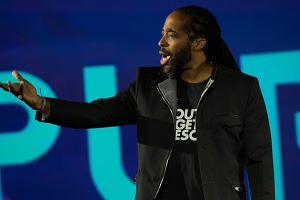
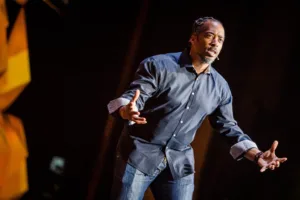
In this new world, our most valuable asset isn’t our AI; it’s our authenticity. It’s our un-automated heart. As a Grammy Nominated Spoken Word Artist Sekou Andrews, I’ve learned that the most powerful connections aren’t forged in perfect grammar, but in palpable feeling. The entire craft of spoken word poetry is built on this truth. It’s not about reciting words; it’s about revealing a piece of your soul so that others can see a piece of theirs. This is what the best communicators, the top leaders, and the most inspiring people do. They operate on a few core principles:
- They aim for the goosebump, not just the data point. They understand that data informs, but story transforms. They use story as the vehicle and data as the destination, knowing the experience of the journey is what everyone remembers.
- They speak with their scars, not just their stats. They aren’t afraid to be human, to be vulnerable, to show the cracks where the light gets in. This is how you give others the chance to find their story in yours.
- They listen for the story, not just for their turn to talk. They practice effective story-listening, hearing the unspoken scriptures that whisper the secrets to connection. They don’t just hear words; they hear heartbeats.
So how do we apply this? We stop trying to optimize the humanity out of our interactions. We stop speaking to people like they’re business cards. As a leader, as a teammate, as a spoken word artist in your own field, your job is to be the human API—the one who translates the cold, hard code of business into the warm, resonant language of human experience. Use the bionic parts of your enterprise to enable the jobs the robots can’t do: the empathy, the kinship, the ability to make someone feel heard, seen, and understood. The world’s best brands and the most inspirational leaders are not the ones with the slickest automation; they are the ones who are unapologetically, indelibly human. This is the work of a true Vanguard Artist, no matter your industry.
Let’s not just build smarter tech; let’s become wiser humans. Let’s make a pact to use our tools not as a shield to hide behind, but as a bridge to connect with. Because in an age of automation, the most disruptive, most innovative, and most valuable thing you can be is yourself. The ultimate upgrade isn’t a new piece of software; it’s your own un-automated heart, beating with the messy, beautiful, and powerful rhythm of authentic human connection. That’s the feeling no algorithm can replicate, the story no chatbot can tell, and the goosebump that reminds us we’re alive.