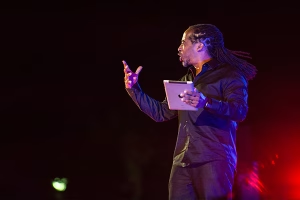
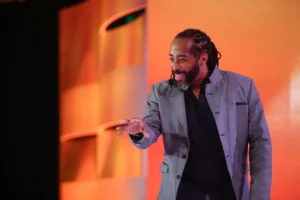
Some stories inform. Others inspire. But the best stories? The ones that move. Move hearts. Move teams. Move markets. And no one knows how to move an audience quite like a spoken word artist.
I’ve stood on stages from TED Talks to Madison Square Garden, from classrooms to boardrooms. And I’ve learned this: the true currency of influence isn’t facts—it’s feeling. If you want to make your audience act, you’ve got to make them feel.
Storytelling in business isn’t a buzzword—it’s a battle cry. Because in a world of copy-and-paste pitches and PowerPoints that put you to sleep, the spoken word artist brings a bold new energy: truth wrapped in technique, vulnerability wrapped in victory.
Let me show you what I mean.
A sales pitch becomes a scene. A vision statement becomes a verse. A product launch becomes a performance.
Spoken word storytelling isn’t about performance for performance’s sake—it’s about piercing through the predictable. It’s about reaching the part of your audience that logic alone can’t touch. It’s heart-first communication with a bottom-line bonus.
Here’s the formula:
- Emotion + Precision = Engagement
- Authenticity + Structure = Impact
- Voice + Vision = Momentum
When you layer those together, you don’t just tell a story—you create a shared experience. One where your audience sees themselves reflected in your narrative. One where they don’t just remember your brand—they believe in it.
So, what does this mean for you as a business leader, speaker, or brand builder? It means you have to speak beyond the bullet point. Tap into metaphor. Use rhythm to keep attention. Let silence stretch long enough to spark introspection. Tell your story with the kind of grit, grace, and groove that makes people say, “That…that’s what I needed to hear.”
Because in the end, it’s not about telling a story that impresses. It’s about telling a story that moves.
And if you do it right?
That movement becomes momentum.
That momentum becomes trust.
And that trust?
It becomes transformation.