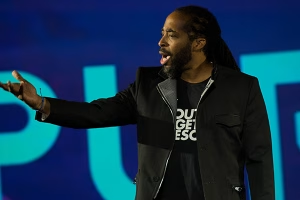
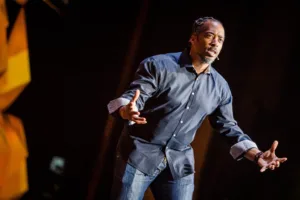
You know the room. I do. I’ve seen it from a hundred stages. The air is so thick with titles and trajectories you could cut it with a business card. Everyone’s wearing their professional armor, their game face, their carefully curated LinkedIn summary. We shake hands, but we don’t connect. We network, but we don’t build trust. Why? Because everyone is performing, and nobody is being. We’re all waiting for someone else to be human first. As a Grammy nominated spoken word artist, my job is to crack that armor, but I learned a long time ago you can’t do it with a hammer. You have to do it with a key. And that key, more often than not, is showing them your own scars first.
The Case of the Cardiologists
I remember standing backstage, about to speak to a room full of cardiologists. You know how they get down, right? That’s a lit crowd. (Kidding.) I could feel the skepticism from the green room. These are brilliant, analytical, data-driven minds who spend their days looking at the literal, mechanical pump inside our chests. They’re waiting for Dr. Andrews. They’re expecting a keynote full of peer-reviewed data and intellectual bravado. And I’m up there, a spoken word poet, feeling like I brought a microphone to a scalpel fight. My usual tools—metaphor, rhythm, story—felt flimsy against their wall of scientific certainty.
I had a choice. I could either try to perform the role of an expert they’d respect, speaking to their business cards and trying to impress them with what I knew. Or I could do something much more terrifying: I could speak to the human being inside the white coat. I could lead with my own vulnerability. So I walked out there and I didn’t talk about their work; I talked about the purpose behind their work. I didn’t talk about EKG readings; I talked about watching my dad’s heart monitor after his surgery, and how that steady, rhythmic beep was the most beautiful poem I had ever heard. I didn’t lecture; I shared. I didn’t present my credentials; I showed them my heart. I decided to bleed first.
The ROI of a Real Connection
And then, the most amazing thing happened. The armor in the room didn’t just crack; it dissolved. Shoulders relaxed. The arms that were crossed, uncrossed. The intellectual shields came down, and for a few minutes, we weren’t a speaker and an audience. We were just a room full of humans who have all loved someone, lost someone, and feared for someone. After the talk, a doctor came up to me, his eyes wide. He said, “That was one of the most inspirational things I’ve ever heard. So, wait… you’re not a doctor?” I just smiled and popped my collar. That, right there, was the win. Not because I’d fooled him, but because I had connected with him so deeply that he saw me as one of his own. We had an unspoken handshake, a moment of trust built not on a shared profession, but on a shared humanity.
Trust isn’t a transaction; it’s a transfusion. It requires you to give a piece of yourself. It asks you to stop polishing your shield and start showing your scars. Your scars tell a story of survival. They prove you’ve been in the arena. They are the receipts for the wisdom you’ve earned. The top leaders, the ones who create unshakable loyalty, aren’t the ones with the flawless record; they’re the ones who are human enough to have a record at all. They know that to get their team to be vulnerable, they have to have the audacity to go first. So stop speaking to business cards. Stop trying to be the smartest person in the room and just try to be the most human. Show them the hairline fractures. Show them the beautiful bruise from where you failed forward. Show them the stitch marks where a lesson healed into wisdom. Because your title may get you in the door, but it’s your story—your real, vulnerable, scarred-up story—that will get you a seat in their heart.