If you’re not failing forward, you’re falling behind.
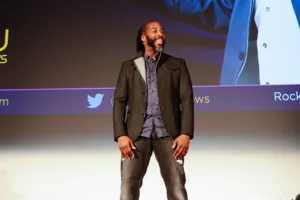
We’ve all been there. That moment the presentation flatlines. The project goes sideways. The sure thing becomes… well, not so sure. Our culture teaches us to see that as the end. Game over. You fell behind. But as a Grammy Nominated Spoken Word Artist who has spent a career turning stages into laboratories for ideas, I’ve learned that falling isn’t the opposite of success. It’s a core ingredient. You can’t blaze a trail if you’re afraid to fail. You win some, you learn some. The only way to not fall behind is to get really, really good at failing forward. Here’s the blueprint.
- Make Failure Your New Fashion Statement.Yeah, you heard me. Stock Chanel splints in the C-suite. Hand out Armani gauze in your sales meetings. Your best teacher is your last mistake, so why are you hiding the lesson plan? Wear that intellectual capital like proud battle scars. When you create a safe space for your team to fail forward, you’re not celebrating mistakes; you’re celebrating the courage it takes to risk deeper. This isn’t just spoken word poetry; it’s a strategy. If every attempt ends with an easy win, you aren’t aiming high enough.
- Say “Yes, And…” to the Mess.In improv, the foundational rule is “Yes, and…” Whatever your partner gives you, you accept it and build on it. Disruption is that scene partner who throws you a curveball. It’s rude. It’s relentless. It doesn’t RSVP. So, beat it to the punchline. When things go wrong, say, “Yes, and watch what I do with it.” When a new challenge appears, say, “Yes, and watch where I take it.” The most inspiring leaders don’t just react to disruption; they embody it. They learn to transform the unexpected into the unforgettable.
- Cross-Pollinate Your Problems.Remember that Harvard study? Carpenters trying to build a better mask got their most radical ideas not from other carpenters, but from inline skaters. The more distant the field, the more novel the ideas. Stop networking only with people who do what you do. Go to the breakout session that has nothing to do with your job. Ask the marketing intern for their take on a logistics problem. Diversity is disruption. A homogenous culture reinforces homogenous decisions. It’s a leading practice for any team that wants to break out of the echo chamber and find a truly innovative solution.
- Hire for Combustion, Not Comfort.Birds of a feather flock together. And then they all think the same thoughts. That’s great for comfort, but terrible for growth. High-performance energy doesn’t come from comfort; it comes from collision. You need to be bold enough to pass on building the next banana pancake team and go build the pulled pork and grilled plantain panini team. You, chocolate, have got to meet up with chipotle. When you attract people based on a sameness of purpose instead of a sameness of perspective, you create a foundation strong enough to handle the beautiful, messy, brilliant combustion of diverse ideas. It’s what the world’s best and top-performing companies do.
- Humanize Yourself First.The greatest way we can show our strength is to show our vulnerability. As a motivational poet, I’m never speaking to a job title on a business card. I’m always speaking to the human being who feels broken and unseen and overwhelmed. I’m speaking to the fallen, and the almost fallen, and those fearful of becoming fallen. Because that’s where real connection happens. Stop trying to be the flawless hero and be the human who has the scars to prove they’ve been in the fight. That’s how you build trust. That’s how you inspire loyalty. That’s how you earn the right to lead.
So, the next time you’re on the verge of something new, don’t ask, “What if I fail?” Ask, “How can I fail forward?” How can you turn a stumble into a pivot? A scar into a story? A mistake into a masterpiece? This is how you become a Vanguard Artist in your own industry. It’s what I, Grammy Nominated Poet Sekou, believe is the best way to innovate. This is more than just spoken word or some cute instapoetry; it’s the key to your most inspirational work. It’s the difference between asking, “Why did I think of that?” and “Why didn’t I think like that?” Now go get some beautiful bruises.