You’ve been in that meeting. We all have. The one where an idea, fragile and full of shimmering potential, is taking its first breath. It’s exciting. It’s a little scary. And then it happens. The “Yeah, but…” guy speaks up. Or the “No, but…” lady. Or the “Have we considered the logistical ramifications of that at scale?” executive. Same person, different suit. They are the professional dream-killers, the project management medication you have to take just to get through the day. They’re not bad people; they’re just afraid. Afraid to fail, afraid to look stupid, afraid to leave the beautifully paved, perfectly predictable highway of “how it’s always been done.” And in that fear, they turn the boardroom into a graveyard where every promising “What if?” goes to die. They hit the brakes on momentum and replace it with a committee, an acronym, and a six-month feasibility study that ends up right where you started.
I remember my first improv class. It was terrifying. You stand in a circle of strangers, and the only rule is you can’t say no. The foundational principle is “Yes, And.” Whatever your scene partner gives you—no matter how ridiculous—you have to accept it as reality and then build on it. The first time someone looked at me with a straight face and said, “Captain, the ship is being boarded by sentient, tap-dancing squirrels,” my brain screamed, “NO! That’s stupid!” But the rule is the rule. So, I took a breath and replied, “Yes, they’ve boarded, and they’re demanding we surrender our entire supply of tiny top hats!” The room erupted. In that moment, we didn’t just create a scene; we created a world. We traded fear for fun. We transformed a potential dead end into a hilarious new direction. We took a risk, and instead of piercing an organ, we just pierced the silence with laughter.
That moment of switching from “No, that’s absurd” to “Yes, and here’s how” was a revelation. It’s the machete-shaped lens of a trailblazer. As a Spoken Word Artist, my entire career is built on taking an audience on a journey they don’t see coming, but the real secret isn’t in the performance; it’s in the mindset. The “No, but” response is rooted in a desire to control the narrative, to stick to the script. It’s a defense mechanism. But the “Yes, And” mindset is an act of collaborative creation. It’s a recognition that the best ideas are rarely born fully formed from a single mind. They are the product of collision, of one person’s spark meeting another’s kindling. It’s about having the audacity to see an obstacle not as a wall, but as a vaulting horse.
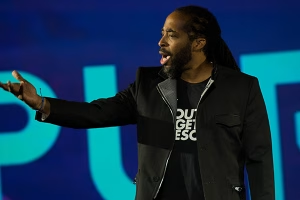
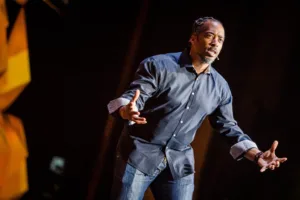
As a Grammy Nominated Spoken Word Artist, Sekou Andrews, I’ve learned that the best leaders are the best improvisers. They create a culture where disruption isn’t a rude interruption but an invitation to dance. This is the “Yes, And” principle in action. A team member says, “Our competitor just launched a new feature.” The “No, But” leader says, “Yeah, but we don’t have the budget to match it.” The “Yes, And” leader says, “Yes, they did, and that gives us the perfect opportunity to survey our own customers about what they really want.” See the difference? One is a dead end; the other is a new beginning. It’s how you get the chocolate and chipotle of innovation—by being bold enough to pair ideas that convention tells you don’t belong together. This is the work of a Vanguard Artist in business, using what is arguably one of the world’s best tools for growth: acceptance and amplification.
So I ask you, what kind of space are you creating? Is it a stage or a courtroom? Are you empowering your people to bring you their half-baked, brilliant, terrifying ideas, or have you trained them to only present the safe, sanitized, and ultimately stagnant ones? To become one of the most inspiring leaders in your field, you have to create a safe space to fail forward. You have to be the one who hears “we’re losing market share to a startup” and responds with, “Yes, we are, and that’s our cue to act like one.” You can’t just talk about innovation; you have to embody it. You have to be the Chief “Yes, And” Officer of your organization, the one who proves that the quickest path to the top isn’t a straight line, but a series of collaborative leaps of faith.
Ultimately, a “No, but” culture is a story that ends with a period. It’s final. It’s a closed door. A “Yes, And” culture is a story that ends with an ellipsis… an invitation for the sequel, for the next chapter, for the return of the hero. This is the kind of spoken word poetry that writes itself not on a page, but in the DNA of your company. It’s the shift from simply managing what is, to co-creating what could be. It’s how you get a team that doesn’t just follow you, but builds with you. And as your Grammy Nominated Poet, Sekou, I’m telling you, that’s a story worth being a part of. It’s a story that never truly ends, because every time someone says, “I have an idea…” you’re already there, ready to say, “Yes… and…”