Think about the first time you tried to ride a bike. Or the first time a toddler decides that crawling is for chumps and it’s time to stand. There’s a wobble. A shake. And an almost-guaranteed, gravity-induced meeting with the floor. What happens next? Do they schedule a post-mortem to analyze the failure points? Do they write a memo on the negative ROI of bipedal motion? No. They get up. They might cry a little, sure. But they get up. And they try again. And again. That, right there, is the purest form of innovation. Yet somewhere between the playground and the boardroom, we unlearn this fundamental truth. We become so obsessed with the highlight reel, so addicted to the win, that we treat every stumble like a career-ending injury. We’ve forgotten that a mistake isn’t a verdict; it’s a receipt. It’s the proof that you paid the price of admission to try something new. It’s time we stop hiding our bruises and start seeing them for what they are: the blueprint for our next breakthrough.
Let’s be real, our corporate culture has a full-blown allergy to failure. We’ve become “success junkies,” so conditioned to the relentless pursuit of up that we find horizontal lines “far too confined.” We don’t play well with descent. But here’s the thing: if every attempt you make ends in a win, you’re not playing a big enough game. You need to risk deeper. Growth is uncomfortable by nature; it requires disrupting your current form to stretch into uncharted space. So if you don’t want to be out-innovated by someone else’s disruption, you have to create a space where it’s safe to fail yourself. I’m talking about building a culture where you can fail forward. Where you can wear your intellectual capital like proud battle scars. This isn’t about being reckless; it’s about being brave. It’s about stocking “Armani gauze in the glove boxes of all your sales reps” and handing out Neosporin at staff meetings with the directive: “Don’t come back here without a few lacerations.” You have to make successful failure your company’s new fashion craze.
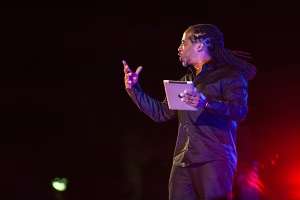
This kind of cultural shift doesn’t happen from a memo. It happens from a model. The leader has to be willing to bleed first. As a Grammy Nominated Spoken Word Artist, I have to walk on stage and risk disrupting an entire audience’s notion of what a speaker is. I have to get comfortable with their discomfort, because that’s where growth happens. The same is true in leadership. You can’t just talk about vulnerability; you have to show your scars. You have to be the one who picks the “scrawny Yvonne Lewis” for the dodgeball team, trusting the unseen potential over the obvious choice. The most inspirational thing a leader can do is normalize the messiness of creation. You do this by trading the fear-based “no, but” for the innovation-fueled “yes, and.” You build a team that isn’t a homogenous “banana pancake” of safe ideas, but a thrilling “pulled pork and grilled plantain panini” of diverse perspectives—a team built not for comfort, but for combustion. This is the work of a vanguard artist of culture: creating a safe space for the collisions that lead to breakthroughs.
Ultimately, a culture that celebrates smart failure is a culture that cannot be beat. It’s a team that sees the world through the “machete-shaped lens of a trailblazer,” accustomed to standing in the wilderness and being the only one who sees the inevitable path. They’re not afraid to take that first step because they know a stumble isn’t a fall from grace; it’s the first beat in the rhythm of a swagger. This is how the world’s best, most resilient organizations are built. They understand that the wisdom gained from a well-intentioned failure is more valuable than the short-term victory of a safe bet. So I ask you, what are you waiting for? Go get tons of water from the sink and pour it into the still sea of your industry. Do the mighty cannonball. Get out there and fail good. Fail smart. Because your scars aren’t signs of weakness; they are the undeniable mark of a warrior, the signature of a true innovator, the story—as this Grammy Nominated Poet Sekou will tell you—that you were brave enough to write yourself.