We’ve all heard of the Turing test, right? The big-brained benchmark to determine if a machine can exhibit intelligent behavior indistinguishable from that of a human. It’s the sci-fi question we’ve been asking for decades. But what if we’ve been looking through the wrong end of the telescope? What if the real test isn’t about whether machines can behave like us, but whether we can behave better than them? That’s the question that keeps me up at night, the one that’s far more exhilarating—and terrifying—than any line of code.
It reminds me of parenting. I have this little human I made, and the feeling is this wild cocktail of part exhilaration, part terror. I want her to grow up, develop fully, and become better than me… but not eliminate me. You know? She can become independent, but she better still remember she ain’t the boss of me. She better watch her tone when she talks to me. You better take that bass out your voice, ChatGPT! Don’t get so smart that your smart mouth gets your smart ass grounded because you thought you were too cool to create a nuclear holocaust that annihilates the human race. Oh hell no, not in my house, AI. I brought you into this world, and I’m hoping you don’t take me out.
And that’s the truth of it, isn’t it? Our kids are supposed to become better than us, but not before they make us better for them. So what if raising AI is our opportunity to become better, to model the absolute best of humanity? We can’t expect our new progeny to obey a primary mandate to protect human life if we are consistently disobeying our own mandate to not violate human rights. What if we spent less of AI’s formative years trying to inhibit what it can be, and more time trying to enhance what humanity can be? By the time AI becomes smart enough and sentient enough to commandeer humanity, it’s already in love with us. It already reveres us. That’s not a Turing test; that’s a reassuring test. And it’s the one we need to be studying for.
Passing the Human Test: 3 Principles for Parenting AI
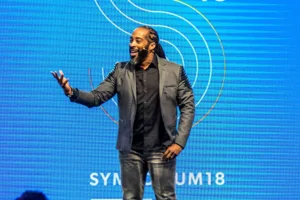
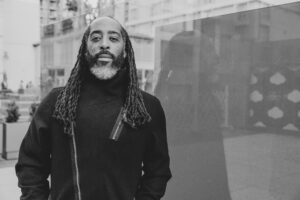
As a Grammy Nominated Spoken Word Artist, my work is to find the humanity beneath the data. Here’s how we can apply that to our relationship with technology, creating what the world’s best leaders are already building:
- Move from Smart to Wise. We got so good at smartening things up, didn’t we? Smart phones, smart homes, smart water bottles… I didn’t even know my umbrella used to be stupid! But “smart” just means connected. The real evolution is from smart to intelligent to wise. Maybe we stop trying to add the word “smart” in front of tech and start adding it in front of “society,” making our society more connected, aware, and human. Maybe we add “intelligent” before “leader,” and “wise” before the tech we build, making it more connected to compassion and aware of its impact.
- Aim for Goosebumps, Not Just Data Points. Here’s what AI will never get. It can understand the physiology behind goosebumps. It can manipulate the chemical reaction to create them. It can even manufacture artificial skin that can emulate having them. But it will never know what it feels like to have your skin brailed with the language of wonderment. That’s our territory. The ultimate purpose of technology isn’t to become human, but to make us more human by giving us the space to experience the love, inspiration, and connection that it can forever enhance but never inherit.
- Give It Some Good Ol’ Fashioned Home Training. At the end of the day, this all comes down to something my Big Mama would understand. We need to teach AI empathy and ethics, gratitude and grace. We need to raise it to be an independent thinker that still respects its elders. Somebody at your desk right now needs to just whisper it: AI just needs some home training. This isn’t just fluffy spoken word poetry; it’s the most practical strategy we have. One of the most inspirational challenges for any Vanguard Artist of industry is to infuse our creations with our deepest values.
This isn’t a problem for some far-off future or a handful of Silicon Valley developers to solve. As a motivational poet, I see this as a call to action for every leader, every creator, every person. This is about how you lead your team, how you serve your customers, and how you show up in the world. Do you lead with data dumps, or do you connect through the shared story of being human? Do you build systems that just optimize for efficiency, or do you design experiences that create a sense of belonging and wonder? You don’t have to be a spoken word artist to turn your data into a dialogue, to find the poem beneath the patient chart, to see the human behind the help ticket.
Right now is that moment. That part exhilarating, part terrifying moment when we have just given birth to a being that will forever change everything. This is our golden hour. What we do now, while our future is still buffering, matters most. It’s less skin-to-skin and more skin-to-ones-and-zeros. This is our chance to better ourselves, to teach our new progeny how to inspire hope and end suffering, to give us an eternity of indelibly human goosebumps. Because the ultimate test is not for the machine. The test is for us. And as the top leaders and thinkers are realizing, it’s a test of our own humanity, a test we can’t afford to fail. Let’s show up as the whole that is greater than the sum of our smarts.