I remember the moment clearly.
I was a young elementary school teacher in South Central Los Angeles, standing in front of a classroom armed with the lesson plan, the subject knowledge, the “right” answers, and all the other content I thought mattered.
And yet, none of it was landing.
The content was solid.
The curriculum was sound.
But the classroom was… somewhere else.
Eyes wandering. Minds disconnected. Potential… unmoved.
That was the day I learned what the best teachers understand:
Knowing how to do something is not the same as knowing how to teach it.
The Shift From Information to Impact
That’s when I understood how much I disagree with the old adage:
“Those who can’t do, teach”
Because teaching isn’t about what you know how to do.
It’s about what your student will be empowered to do because of what you know. Because of your expertise in empowering the doing in others.
I had to unlearn the idea that my job was to deliver information.
My job was to inspire possibility, to create transformation.
To take something intimidating and make it accessible.
To take something abstract and make it actionable.
To keep decrypting the code, keep cracking the safe, until the student and I both finally hear that faint “click” that unlocks the vault of their potential.
And that requires a completely different skill set.
The skill of knowing how to dance with a student’s mental development and discovery.
At times to teach them the choreography.
At times to teach them how to freestyle.
And at times just to let them fall in love with dancing.
Teaching is emotional intelligence in motion.
It’s reading the room while rewriting the script in real time.
The Lightbulb That Illuminates the Teacher’s Path
Teachers are known for giving students “lightbulb moments” — those moments the clouds part, the darkness cracks, and a new idea is finally seen.
But every great teacher has also experienced their own light bulb moment with a student.
The student who is brilliant. Quiet. Sitting in the back of the class as if trying to fade into the background of life.
Every assignment incomplete. Every test a struggle.
On paper, it looks like she isn’t capable.
But something tells the teacher that isn’t the truth.
And then one day, it happens — bling! — our lightbulb flickers on and we see a new path.
We stop trying to teach the subject…
and start trying to teach the student.
Different approach. Different language. Different entry point.
Until — bling! — her lightbulb finally flickers on too.
You know the one.
Not the polite nod. Not the “I guess I get it.” I mean the real one.
The eyes widen. The head lifts. The chest broadens. The energy shifts.
“I get it.” yes. But more importantly: “I can do this.”
That moment doesn’t just change her performance. It changes her identity.
The person she thinks she is. The feats she believes she can accomplish.
And in doing so, it changes us too.
Because we realize: That’s the work of being a teacher.
That’s the evidence of “what teachers can do.”
Teaching Through Turbulence
What we don’t talk about enough is this:
No one walks into a learning environment unencumbered.
They walk with the weight of real life. Every step comes with turbulence.
For my formal classroom students the turbulence was two-fold.
The External turbulence:
Growing stomachs from their food desert at home.
Screaming voices from parents getting divorced.
Generational cycles urging them to drop out.
The Internal turbulence:
Their fears of change and limiting beliefs.
Their self-esteem, damaged by their environment, that lowers their expectations for themselves.
The doubt embedded into whispers that ask, “What if I’m not enough for this?”
Great teachers don’t ignore that.
They navigate it.
They teach through it.
Because the real barrier to learning is rarely the content given to the learner. It’s the conflict happening inside the learner.
New Classroom, Same Lesson Plan
The year was 2002. I pulled up to my school to meet with my Principal and tell her that I was quitting teaching to become a full time poet.
As I nervously sat down in her office, exit speech all prepared, before I could open my mouth, she said “You’re leaving me, aren’t you?”
She then proceeded to tell me that, while she was sad her students wouldn’t have me to inspire them anymore, she was also excited for the new set of students who would, “Because,” she said, “I always knew you were meant for a different classroom, for a bigger stage.”
She was right. I left that school, but I never left teaching.
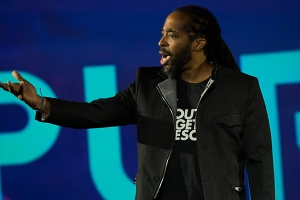
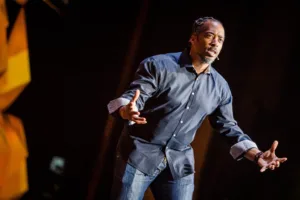
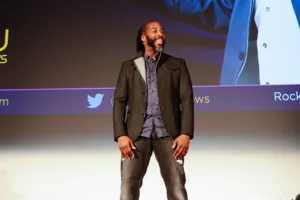
Now, as a keynote speaker, narrative architect, and human resonance expert, I’ve simply taken my inspirational curriculum to bigger, more global classrooms.
Conference stages. Leadership summits. Executive retreats.
Different audience. Different stakes. Same turbulence.
The External turbulence:
Disruption, geo-political uncertainty and unending change.
AI, automation, a new digitized terrain.
New metrics, new expectations, and a new world evolving faster than they can keep up.
The Internal turbulence:
Their fears of change and limiting beliefs.
Imposter syndrome. Loneliness. Disconnection from people and purpose.
The doubt embedded into whispers that ask, “What if I’m not enough for this?”
These days, the code I have to decrypt, the vaults I have to crack open, look like…
Brilliant leaders with powerful ideas… struggling to get their people to act on them.
Strategies that looked amazing on slides… but never made it into behavior.
Rooms full of knowledge… starving for clarity, connection, and conviction.
My students are:
- The executive trying to align a team
- The entrepreneur trying to inspire clients
- The leader trying to drive change
- The speaker trying to spark something real
And I realized that these students — these grown-up, degree-carrying, title-flaunting, suit-and-tie wearing students — didn’t need more information… they needed better teaching.
In a World of Answers, We Still Need Awakening
Right now, we are drowning in answers.
Information is instant.
Knowledge is searchable.
AI can generate insights in seconds.
But here’s what it can’t do:
It can’t stand in front of a room and feel when the message isn’t landing.
It can’t pivot mid-sentence to meet someone exactly where they are.
It can’t look someone in the eye, sense despair, and ignite belief.
Because the missing ingredient isn’t information.
It’s connection.
It’s meaning.
It’s resonance.
It’s that moment when someone doesn’t just see the path…
They see themselves walking it.
Even better, they see themselves creating it.
Seeing that new possibility is the tactical value of delivering information though inspiration.
It makes the information sticky enough to survive the turbulence.
Why This Matters Right Now
If you are a leader, an influencer, a producer of learning experiences, then your audience—whether they sit in corporate offices or conference ballrooms—is still navigating turbulence.
Still questioning. Still hesitating. Still hoping.
They don’t need more content.
They need someone who can amplify the resonance that humanizes the content.
Someone who can architect a new narrative that the student can live into.
Someone who can guide them through the noise…
translate complexity into clarity…
and remind them of what they’re capable of on the other side of it.
They need an expert teacher.
So Here’s the Invitation
This National Teacher Appreciation Week, let’s celebrate the educators who shaped us.
Let’s commit to valuing and empowering them.
And let’s also commit to becoming them.
The world needs more great teachers.
Certified teachers who bring their mastery to formal, scholastic classrooms.
And “IRL” teachers who bring their mastery to real world classrooms…
In leadership.
In business.
In any conversation where critical change is on the table.
So, step into that role.
Speak not just to inform… but to inspire.
Lead not just to manage… but to move.
Communicate not just to explain… but to transform.
Because somewhere, someone is sitting in the back of your “classroom”—whatever that looks like—waiting for their lightbulb moment.
And that can’t happen until, first, you have yours.
Your “A-ha!” moment that reveals your different approach, your different language, your different entry point that demonstrates your true mastery as a teacher.
The mastery of cracking open vaults of possibility, in ways that are indelibly human, to leave someone’s future transformed.
The mastery of making encumbered eyes widen.
Making heavy heads lift.
Making clenched chests broaden.
Making fettered futures shift.
Because a great teacher’s mastery is not just the expertise of doing.
It is also the expertise of undoing — undoing someone’s limitations to empower what they never imagined they could do.